

Air Canada Involuntary Downgrade: From Business Class Back to Economy
- Points and Places

- 4 hours ago
- 4 min read
Air Canada Involuntary Downgrade: From Business Class Back to Economy
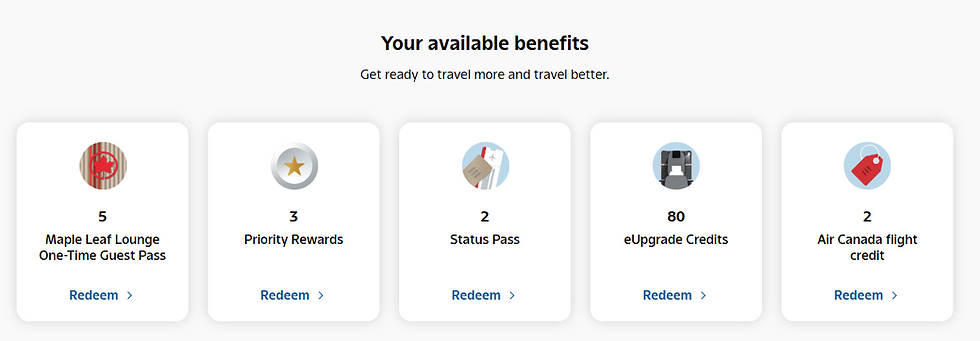
If you have Aeroplan status with Air Canada, you probably have a stack of eUpgrade credits in your account. They are marketed as a key benefit in the program, and when they clear, the value can be significant. This is especially true on long-haul flights, where a lie-flat seat can make a real difference in comfort.
What is rarely discussed is what happens when a confirmed upgrade disappears.
On a recent trip, I experienced exactly that: a confirmed Business Class eUpgrade that ultimately became an Economy boarding pass. The experience was confusing and frustrating, but it highlighted how upgrade priority actually works when airline operations shift. If you rely on Air Canada eUpgrades, especially at lower Aeroplan status tiers, this story is essential reading.
A Quick Refresher on Air Canada eUpgrades
Aeroplan status members receive eUpgrade credits as part of their annual and milestone benefits. These credits can be applied to eligible paid fares or Aeroplan reward bookings to move into a higher cabin, subject to availability and priority rules.
Upgrade priority is determined by several factors: your status tier, the fare purchased, the cabin originally booked, and the availability of R space, which is Air Canada’s upgrade inventory. At the 25K status level, you sit near the bottom of the hierarchy. On lightly loaded routes, that may not matter, but on competitive flights, it is a key factor.
You can improve your upgrade position in a few ways. Booking Premium Economy instead of Economy places you ahead of Economy passengers. Choosing a Flex fare allows upgrades to clear as soon as R space becomes available, rather than waiting for a clearance window.
For this trip, we booked strategically to maximize our priority for an upgrade.
The Booking
We booked Premium Economy Flex and immediately applied our eUpgrade credits. No R space was available at the time of booking, so we were waitlisted. About a week later, the upgrade cleared into Business Class. Seats were assigned in the app, and everything appeared finalized. At that point, our strategy had worked, and we were seated in Business Class.

Then, on the day of departure, the situation began to change.
First Aircraft Change
While checking in, I noticed the aircraft had changed to a smaller configuration with fewer Business Class seats. That is rarely good news when traveling on an upgrade. When premium cabin capacity shrinks, upgraded passengers are typically the first to be affected.
Expecting the worst, I checked the seat map. Surprisingly, our Business seats remained intact. For a few hours, it appeared we had avoided the impact of the swap.
Aircraft Change Again
Shortly before leaving for the airport, the aircraft changed back to the original configuration, restoring the full Business Class cabin. Logically, that should have stabilized the situation.
Instead, we received a cabin class change notification. We were reassigned to Economy, not Premium Economy, the cabin we had originally paid for. At the same time, we appeared far down the upgrade list, roughly 25th in line. The aircraft configuration was effectively the same as when the upgrade originally cleared, but the seats were no longer ours.

Calling Air Canada
On the drive to the airport, I called Air Canada for clarification. The agent indicated that we still held Business Class seats, but seat numbers could not be assigned because the flight was under airport control. I was assured the issue would be resolved at the airport.
It was not.
At the Airport
At check-in, we were ticketed in Economy. There were no Business seats available and no Premium Economy seats either. The staff at the Business counter tried their best to resolve the situation. Despite involving several managers, we ultimately remained in Economy, even though we had booked Premium Economy and later cleared into Business.

What Likely Happened
Air Canada did not provide a detailed explanation, but situations like this usually occur when aircraft swaps trigger seat reprocessing. When a plane changes, the system reallocates seats based on ticketed class, cabin configuration, revenue protection, and published upgrade priority rules. Revenue Business Class passengers are protected first, and upgraded passengers are prioritized according to their status and fare.
Other operational factors can also affect seating, such as deadheading pilots or inoperative seats. At lower tiers, even a previously cleared upgrade can be vulnerable during these reshuffles. In this case, losing Business Class was frustrating enough, but also losing Premium Economy highlights how operational changes can cascade through multiple cabins, reshuffling passengers in ways that may seem unfair and unpredictable.
Compensation
To Air Canada’s credit, the fare difference from Premium Economy to Economy was refunded, and additional compensation was provided. If you are simply downgraded back to the cabin you originally booked, you should not expect compensation.
If you experience an involuntary downgrade from the cabin you purchased, it is worth requesting the difference between the cabin booked and the cabin flown, as well as any additional compensation depending on the situation. Additional compensation beyond the fare difference is not guaranteed, but it is always worth asking. In our case, the request was successful, but it should be viewed as a bonus rather than an entitlement.
What This Means for Using eUpgrades
This experience did not diminish the value of Air Canada eUpgrades. They remain powerful tools within the Aeroplan program.
It did, however, clarify their limitations. At 25K, you are realistically among the first to be displaced when operational changes occur. Even a cleared upgrade should be viewed as highly likely, not guaranteed.
If Business Class is essential, particularly on overnight or long-haul flights, booking the cabin outright is the safest way to eliminate uncertainty. On shorter routes, the calculated risk of relying on eUpgrades may be reasonable.
Final Thoughts
eUpgrades remain one of the strongest benefits of Aeroplan status, particularly at higher status tiers. Used strategically, they can unlock significant value.
If you want a specific cabin, book it outright. Even a cleared upgrade should be viewed as highly likely, not guaranteed. Understanding the hierarchy and setting realistic expectations will help you manage your travel experience and avoid frustration.

